
A Devil’s Bargain Between Tax Revenue and Public Health:
Texas Needs a Data Center Moratorium to Address Off-Grid, Gas-Powered Data Centers
SUMMARY:
On August 3rd, 2026, Greg Abbott paused the number of data centers on the Texas grid. While this was necessary, it was not enough.
With rapid data center growth hitting America: a new form of data center is emerging: the behind-the-meter data center. These data centers bring their own power source, normally in the form of gas power. This is unprecedented – in decades, the vast majority of data centers have been on the grid. The scale of behind-the-meter data centers seems both staggering and impressive, the health problems they present to neighboring communities have become worldwide news. There are now multiple class action suits in Tennessee and Mississippi against the owners of behind-the-meter data centers due to health concerns. Officials in Granbury, Texas are being recalled due to their pro-data center positions on nearby data centers.
The anti-data center movement is not being fueled by Chinese propaganda on Facebook. This report provides independent research on the health impacts presented by data centers, particularly behind-the-meter facilities. It evaluates other criteria such as job creation and long-term viability for these facilities.
Texas should pass a moratorium on all data centers until we can fully evaluate all of their impacts including public health and other traditional Texas industries such as ranching and agriculture – not just their potential for tax revenue. While the tech industry idolizes “moving fast and breaking things,” human beings are not codebases. We can’t roll back devastating health impacts caused by the air and noise pollution they’ve already caused.
About the author:
Michelle Greer is a technologist, former journalist, and citizen of Bastrop county. She has worked in Infrastructure Product Marketing and Sales at Dell, HashiCorp (now part of IBM), and Rackspace. This report was independently commissioned by residents of Bastrop county, due to concerns around the gas-powered EdgeConnex data center proposed in Cedar Creek.
Introduction:
Data centers are not new in America. There are at least 674 known data centers in Virginia alone. These data centers generate billions in tax revenue across their state.
The Texas Legislature recognized this opportunity when they passed the JETI Act, and data center companies responded in kind. They applied for tax abatements and sought property in droves. According to a new report,
“Interconnection queue requests total about 474 GW, which “is more than five times Texas’ record peak electricity demand for ERCOT. Approximately 90 percent of the new power requests are data centers.”
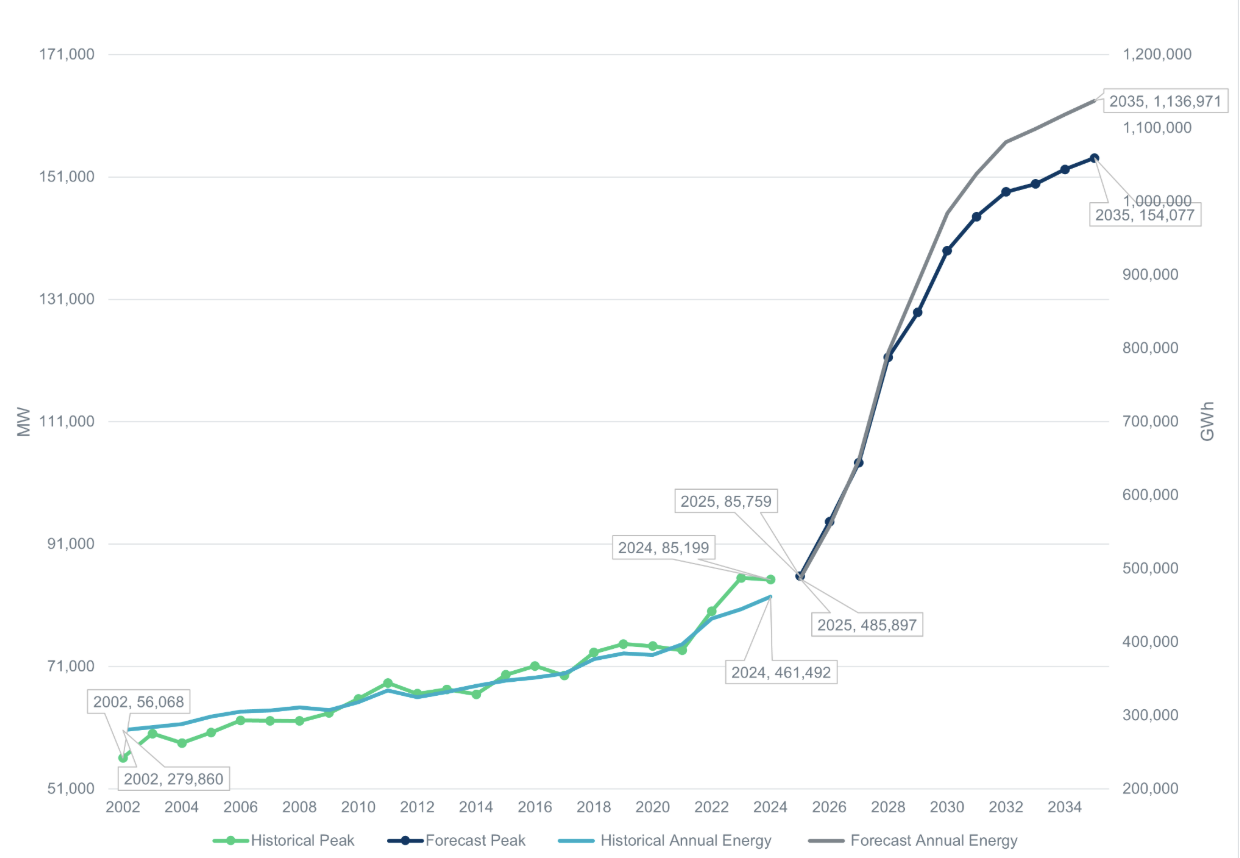
Even if public opinion in Texas had not soured on data centers, Texas couldn’t meet the demand for this energy even if we wanted to. To address these concerns, Greg Abbott put a pause on data centers until they agreed to “bring their own power,” among other requirements. Data center companies are now choosing to go “behind the meter” by bringing their own energy sources, generally in the form of a gas power plant. Data center companies are already getting permits to build these gas-powered data centers in Pecos and now in Cedar Creek. The Pecos data center has already garnered international news, as it is speculated that its new power plant will generate “more pollution than any power plant in America.” The proposed Cedar Creek facility is surrounded by thousands of residents and backs a children’s school.
We are entering new territory with no blueprint to follow. Data centers have always traditionally run on the grid. These data centers generate pollution when they test their backup generators, but this level of pollution was generally mitigated by reliable electricity. After all, if the power is always running, their generators are rarely needed.
On the other hand, gas-powered data centers introduce an unprecedented level of potential public health concerns for Texans. We have very little public health data on communities near these data centers, but what we do have is alarming. There is just one gas-powered data center in Virginia out of hundreds. Nearby communities were alarmed about it, so an environmental group conducted a study. It concluded that this single data center could cost millions of dollars in annual public-health costs for Virginians, and showed that the gas traveled for miles into nearby cities. The study was evaluated by the Virginia Department of Environmental Quality, but the agency took the concerns seriously. They now heavily monitor air quality across Virginia’s “Data Center Alley” region.
Other behind-the-meter data centers validate the concerns presented in Virginia:
The xAI “Colossus” data center has been called “the epicenter of the data center debate.” Visiting journalists have noted the “rotten cabbage”-like gas odor, and residents complain “they can’t breathe at home.”
The presence of the “Colossus 2” xAI data center in Southaven, Mississippi, which has similar concerns to the Colossus buildout. Residents have sleepless nights from the noise, and liken the experience to “being tortured.”
Both communities have filed class action suits against xAI. Journalists ranging from NBC, Texas Tribune, the New York Times, to even France24 have visited these sites to get firsthand accounts of the dangers they present.
Off-Grid Gas-Powered Data Centers Create Unprecedented Public Health Risks
Traditionally, data center buildings look like random office buildings in the middle of nowhere. While they’re loud inside, they generally use sound dampening equipment to mitigate the impacts to the outside world. They often have gas turbines for backup power, but these are rarely used and mostly just tested.
The equipment isn’t heavily regulated, and some data centers are better neighbors than others.
The behind-the-meter data centers hitting the market now don’t fit this description at all. A data center can use as much energy as a small town, and behind-the-meter data centers must meet this need at every individual site. Generally, they do this with natural gas. This releases smog-forming nitrogen oxides, formaldehyde, and fine particulate matter into the air. A study by the NIH described fossil-fuel power plants are “localized sources of elevated air pollution.” Their study concluded that proximity to a single fuel-fired power plant caused an 11%, 15%, and 17% increases in estimated rates of hospitalization for asthma, ARI, and COPD, respectively, among individuals > 10 years of age living in a ZIP code containing a fuel-fired power plant.”
The Southern Environmental Law Center evaluated a behind-the-meter data center’s gas power plant specifically. Their independent study on the air surrounding the Colossus 2 plant in Mississippi found the following:
Some communities could see increases of fine particle pollution of .5 micrograms per cubic meter, a level linked to an increase in per-person mortality risk comparable in scale to the average annual risk of death from alcohol-impaired driving in the United States.
This risk wasn’t limited to Southaven. Particulates from the power plant travel to *multiple counties* in the area, including Shelby and De Soto county. The report also examined the economic impact of air pollution from the proposed permanent turbines at xAI facility, finding that it could result in an estimated $30-$44 million in annual health damages each year. Those damages are driven by serious health impacts linked to air pollution, including premature deaths, new and worsening asthma, nonfatal heart attacks, hospital visits, and missed school days.
On-prem gas is a new untested model for data centers that is seen as cost prohibitive and unreliable
Oracle was one of the first companies to explore behind-the-meter solutions. Their stock has dropped precipitously despite solid earnings. Why? The high capex costs associated with their buildout in Abilene, TX makes investors nervous.
While these solutions help temporarily, they are not seen as ideal
Sound concerns are often dismissed, but shouldn’t be
All data centers produce noise. The amount depends on the kind of workloads they handle, the modernity of the equipment including fans and chips, and the insulation each building uses. Noise concerns are rarely addressed in the debates on data centers, but nearby residents can suffer greatly if a datacenter does not address the noise it produces.
Traditional data center noise comes from:
Cooling fans, which can be heard from a mile away
Generators tests, which are as loud as a leaf blower, and typically occur 100 times a month.
Behind-the-meter gas-powered data centers running on gas turbines present a new level of noise. Nearby residents have filed lawsuits on multiple occasions, likening the experience of living near one as “torture.” Communities have joined lawsuits, recalled politicians, and raised awareness around the globe about their plight.
More research can be found at the LSAR website. You can hear what a data center sounds like yourself here. According to the NIH, this Low-Frequency Noise (LFN) isn’t just annoying. Their report on LFN states:
Exposure to infrasonic (<20 Hz) and lower frequency airborne pressure waves can cause cellular and tissue damage depending on frequency, dB-level, and exposure time, while the viscoelastic properties inherent to biological tissues impart a nonlinear response to this type of acoustic stressor.[4] Widespread vascular involvement was observed in palpebral and bulbar conjunctiva and retina, gastric mucosa, liver structures, lungs, pleura and tracheae, alveoli, pericardia, and coronary arteries. The whole-body response also elicits the immune system, affects organs of the reproductive system, changes receptor cells in the vestibular semicanals and auditory cochlea, and induces genotoxic effects, including teratogenesis.
The devastating health impacts of LFN have already played out here in Texas. Granbury generates international headlines with the public toll of crypto mining data centers. The community is suing the crypto company and is voting to form a city so they can stop the crypto mines.
Texas is not equipped to handle rural public health crises
Texas already struggles to meet the healthcare needs of its residents. According to the Texas Rural Health Association, 159 out of 169 counties face sufficient Primary Care Physician shortages, and 32 percent of rural hospitals face closure. Texas already ranks #50 of all states on 2025 Scorecard on State Health Performance from the Commonwealth Fund.
Currently, nothing in the JETI Act addresses public health discrepancies. Texas also has the highest rate of uninsured citizens in the United States. Data center related health concerns could overwhelm an already strained rural hospital system.
Texas farms, ranches, and wildlife also suffer
Animals including livestock and wildlife also suffer as a result of data centers. Indeed, farmers and ranchers have been some of the most vocal opponents of data center buildouts, citing issues ranging from water wells running dry to stillborn calves. The land grab is also pricing young farmers and ranchers out of the industry, which should concern everyone. Texans love their fresh fruits and vegetables as well as authentic Texas BBQ.
A Brave New World: There Are No Financials for Behind-the-Meter Data Centers
Data center lobbyists and proposals can talk a big game about how much tax revenue they’ll generate. There are literally no cohorts for behind-the-meter data centers over a ten year period. These numbers should be dismissed entirely. Texas should not be subsidizing exploratory shell companies eager to cash in on the AI craze. We should especially not cover the cost for a data center architecture that has led to lawsuits due to public health concerns and is cost prohibitive to build.
The Austin skyline was riddled with shells of buildings after the dotcom bust, when $5 trillion in market value was erased in a two year period. Could rural data centers suffer the same fate? Data center and AI technology is evolving rapidly. It’s not even clear if today’s data center will even be relevant in five years, much less ten. Could there be data centers in space? Google and SpaceX seem to think so.
Like the internet, social media, cloud, mobile, and crypto crazes of the past few decades, every tech boom cycle has a bust. There are risks for every investment – legislation changes, interest rates go up and down, and new technologies are discovered. Pundits don’t wonder if there is an AI bubble. They discuss when it will crash. Companies deploy infrastructure with the expectation of a return, and so far, 95% of AI agent pilots fail, according to a commonly cited MIT study. This is unsustainable.
Why are both financial and tech pundits predicting the bubble will crash?
While hardware companies and data center companies are seeing record stock prices, most software companies, i.e. their customers, are seeing reduced stock prices.
AI are spending hundreds of billions of dollars to train models, and are losing billions of dollars each year doing it. OpenAI has been around 11 years and lost a minimum of $21 billion last year. For perspective, Amazon, a company traditionally associated with running at a deficit to fuel growth, was already profitable in nine years.
Many open weight models from NVIDIA, Facebook, and Google have entered the market and are small enough to run on a laptop. Unlike frontier models that require unprecedented compute to train and run, these models are free to use.
Enterprises are scrutinizing their AI spend, and are turning to open weight models to save money and ensure data privacy.
“The cost of compute is far beyond the costs of the employee.” - NVIDIA Vice President of Applied Deep Learning Bryan Catanzaro
Texas taxpayers could end up footing the bill for the energy and tax abatements for the AI boom. Technology is full of boom and bust cycles, and we should expect that AI is no different than the dotcom, cloud, mobile, and cryptocurrency booms before it. We shouldn’t force Texans to suffer through this
Debunking jobs numbers
President Trump has promised that OpenAI’s Abilene’s Stargate million-square foot facility would create “100,000 jobs.” After the initial construction period that employed 1500 people, this facility created less than 100 jobs, according to the Wall Street Journal. Research from the Brookings Institute shows that large data center projects often promise only dozens to a few hundred permanent workers while the associated construction jobs are temporary.
Servers, networking, cooling, etc must all be set up and maintained over time. Day-to-day operations of servers occur remotely. Operators deploy, secure, and manage servers via the internet using a Secure Shell (SSH) connection, meaning that they can access the servers anywhere in the world.
Texas’s laws make it impossible for local lawmakers to safely bring data centers to their community
House Bill 2127 , a.k.a. The Death Star bill, limits the capability of city officials to address many of these concerns. County commissioners rely on the legislature to pass laws. This is a double-edged sword for state legislators and executives. It prevents counties from passing their own moratoriums, and puts the burden to fix Texas issues on the legislature itself.
Currently, Texas has no data center laws around:
Easement to protect “quiet enjoyment” of one’s property
Noise and its impacts to humans and livestock
Water or electricity usage
Nearby pollution and air quality
A data center isn’t just another business on the grid. A single data center can use as much electricity and water as a city, and it’s time that Greg Abbott and other legislators acknowledge this truth. Enabling behind-the-meter data centers across Texas solves energy requirements, but will create a public health crisis that we should not ignore and potentially at a scale we cannot at this time even fathom.
Multi-national corporations are exploiting our lack of laws. When Hill County attempted to pass a moratorium to evaluate data centers’ impact on their constituents, the developers sued the county. Projects around the county have been protested by anyone from the average rancher and homeowner to Willie Nelson and Tanya Tucker. These protests are happening across the state. This isn’t “propaganda from China” – it is a failure of legislation in plain sight.
Recommendations
The Texas legislature has failed to address the grievances that already exist across Texas communities from JETI. The public health crisis in Granbury brings international shame to our state and should be addressed, not replicated across the state of Texas. This includes laws and hard requirements around:
Acceptable decibel limits
Easement laws to ensure neighbors are not impacted
Water and energy usage
Job creation
Retention commitments
In addition, any tax abatement should come with clawback clauses. The tech industry may see bubbles, but Texas taxpayers shouldn’t be forced to foot the bill. There should be a means to track and enforce these laws to ensure progress isn’t coming at the expense of Texans.
Furthermore, “bring your own power” data centers that are behind the meter should be prohibited until further studies have been conducted. This option should not be on the table until these are conducted, even without tax abatements. No county should have to choose between tax revenue and public health.
Texas seems to vilify renewable energy while also investing in it. If we want to be the technology and energy leader of the free world without poisoning our own population, we must invest in it. This includes bidirectional grids, solar, and wind. With marine cooling and microgrid technology, China is quickly emerging as an energy leader, and the world will turn to their solutions rather than face the consequences of heavy pollution in their communities.
Texas should remain the energy capital of the world. It’s also a beautiful state that many of us love and are fighting to protect. Rather than poison our communities, let’s build solutions that help Texans, not just Big Tech